
When Being Right Is No Longer Enough
A Nalla Duarte Story About Decision Velocity
The executive team had been waiting 11 days for an answer on a pricing decision. A competitor had unexpectedly reduced capacity in one of the company’s most profitable markets, creating an opportunity to raise prices and selectively pursue customers that suddenly found themselves short of supply. The CEO wanted to move. Sales wanted to move even faster. Operations needed to know how much additional volume the plants could handle. Finance, however, was still analyzing.
Nalla Duarte, the CFO, had built what most people would consider an excellent finance organization. Her team closed the books accurately, forecasts were detailed, reports were carefully reconciled, and board materials were polished. Few people questioned the integrity of the numbers. Yet as she sat in that executive meeting, Nalla realized that the company did not need another accurate report. It needed a decision, and by the time finance finished perfecting its analysis, part of the opportunity had already disappeared.
That experience forced Nalla to reconsider how she measured the value of finance. For years, the organization had focused on familiar standards such as reporting accuracy, forecast variance, close time, budget completion, controls, and compliance. Those measures still mattered, but none of them answered an increasingly important question: how quickly could finance help the organization make a good decision?
That question gets to the heart of Decision Velocity which Nalla defined as
the speed at which an organization can make high-quality decisions that create value. It improves when we make better decisions in the same amount of time, equally good decisions in less time, or both.
Decision Velocity = Decision Quality ÷ Time to Decision
Decision velocity does not mean rushing decisions, sacrificing rigor, or abandoning accuracy. Instead, it recognizes that the value of financial insight is partly determined by when that insight arrives. A perfect answer delivered after an opportunity has disappeared may be economically inferior to a very good answer delivered while management can still act. For CFOs, that distinction is becoming more important as markets move faster, competitive windows narrow, and business leaders expect finance to help them navigate uncertainty in real time.
Nalla recently read CFO.University’s 10 Predictions That Will Shape the CFO Role in 2026. The article foresees CFOs increasingly being judged not simply on pristine forecasts, but on how quickly they enable high-quality decisions. The implication is significant because the finance organization of the future cannot simply become a faster reporting function. It must become a faster decision function.
Nalla decided to test that idea. She asked her leadership team to identify the decisions that created the greatest economic impact across the company. They expected the exercise to produce a long list, but the opposite happened. A relatively small number of recurring decisions accounted for a disproportionate amount of enterprise value: pricing, customer profitability, inventory, capital allocation, hiring, production capacity, cash deployment, and product mix.
Nalla wrote a question on the conference-room whiteboard: “What if we designed finance around these decisions rather than around our reports?”
That question changed the conversation. Her team began referring to the new model as the Decision Factory.
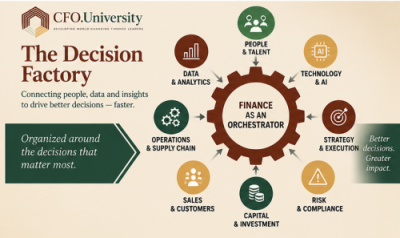
Finance had historically been structured around processes such as close, consolidate, report, budget, forecast, and analyze. Those responsibilities would not disappear, but the team’s highest-value work would increasingly be organized around the decisions management needed to make exceptionally well.
The monthly management report was reduced from 46 pages to 12. Dozens of KPIs disappeared. Scenario analysis increased. Finance partners spent more time with sales, operations, and supply chain leaders, and analysts were encouraged to spend less time explaining last month and more time helping management understand what was changing, why it was changing, what might happen next, what choices existed, and what the financial consequences of those choices could be.
The transformation was not about producing less intelligence. It was about producing more relevant intelligence sooner.
Several months later, the real test arrived when one of the company’s largest suppliers unexpectedly announced a significant price increase. Under the old process, finance would have gathered information, modeled the impact, incorporated revised assumptions into the forecast, and prepared recommendations for the next executive review. This time, the Decision Factory went to work immediately.
Procurement provided supplier information, operations identified alternative materials, sales supplied customer and competitive intelligence, and finance modeled margin exposure, pricing alternatives, customer profitability, and cash consequences. Within 48 hours, management had three scenarios to evaluate. One preserved volume but accepted substantial margin compression. Another passed the full increase to customers but risked losing several important accounts. The third selectively increased prices based on customer profitability, competitive position, and strategic importance.
The analysis was not perfect, but it was decision-ready. Management selected the third scenario and began acting while competitors were still evaluating the situation.
That was the moment Nalla understood the real difference between reporting velocity and decision velocity. Her team had not simply produced analysis faster. It had connected data, business knowledge, scenarios, and financial judgment quickly enough to influence the outcome.
This broader shift is reflected in the language finance leaders are already using to describe the future CFO. At a recent AFP roundtable, participants were asked to describe the future CFO role in five words. Two responses were especially revealing: “Orchestrator of Outcomes” and “Orchestrator of the Finance decision factory.” Those phrases describe something larger than faster FP&A. They suggest a CFO who increasingly sits at the intersection of data, technology, operations, capital, talent, risk, and strategy.
The CFO does not personally own every one of those capabilities, but increasingly must orchestrate them. The objective of that orchestration is not another dashboard or a more elaborate forecast. It is a better business decision.
That requires another important change in thinking. Speed and decision quality should not be viewed as opposing forces. Organizations can make slow, poor decisions, and they can make fast, poor decisions. They can also make very good decisions painfully slowly. The real advantage appears when a company can move toward the upper-right corner of the decision-velocity curve: high decision speed and high decision quality.
Decision Velocity combines two things every CFO should care about: the quality of a decision and the speed at which it can be made. The goal is not simply to make decisions faster, because a fast, poor decision creates little value. Instead, increasing Decision Velocity means shifting the speed-quality relationship: making a higher-quality decision in the same amount of time, making the same-quality decision faster, or ideally doing both.
The graph illustrates this shift.
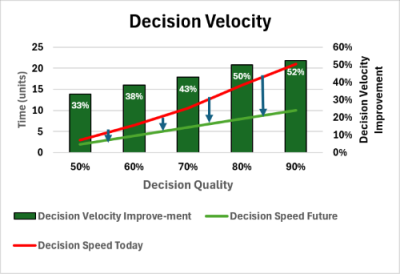
The baseline (red line) represents today’s decision-making capability, while the green improvement line represents a finance organization that converts data into insight and insight into action more effectively. The greater the Decision Velocity, the faster the organization can turn high-quality decisions into business outcomes.
Technology and AI can help finance move in that direction by accelerating data collection, analysis, scenario modeling, and insight generation. Trusted data makes those insights dependable. Storytelling helps executives understand what matters. Business knowledge provides context, while human judgment determines what should actually be done. Decision velocity emerges when all of those capabilities work together.
For CFOs, one practical way to begin is to review recurring finance activities and ask a simple question: “Which business decision does this help someone make?” Some answers will be obvious, while others may be uncomfortable. A report that takes 30 hours to prepare but rarely changes a decision may be less valuable than an analysis that takes three hours and influences a multimillion-dollar pricing decision.
Finance has spent decades becoming more efficient at producing information. The next opportunity is to become more effective at accelerating the conversion of information into action.
For Nalla, that eventually became one of the most important measures on her finance leadership scorecard. The question was no longer simply, “Were we right?” It became, “Were we right soon enough to matter?”
That may be the simplest way to understand Decision Velocity. The highest-performing finance organizations will not be defined by how much information they produce. They will be defined by how effectively they transform data into insight, insight into decisions, and decisions into better business outcomes, and increasingly, by how quickly they make that happen.
Already a Member? Login HERE.
Identify your path to CFO success by taking our CFO Readiness Assessmentᵀᴹ.
Become a Member today and get 30% off on-demand courses and tools!
For the most up to date and relevant accounting, finance, treasury and leadership headlines all in one place subscribe to The Balanced Digest.
Follow us on Linkedin!
