This article is part one of a three-part series, Good Forecasting Is Good Risk Management. I’ll cover why the CFO is often the organization’s de facto chief risk officer, and why finance must build that responsibility into how it works.
Forecasting has a branding problem. Too often, it is treated like an annual ritual, a quarterly update, or the corporate version of “guess the number and defend it later.” Finance gathers assumptions, builds a model, sends around the deck and hopes the future behaves itself. Spoiler alert: It rarely does.
That is why good forecasting is not really about producing one perfectly accurate number. It is about helping the company make faster, more confident decisions under uncertainty.
When you define forecasting that way, it starts to look a lot like risk management.
For many organizations, that makes the CFO the de facto chief risk officer. Not because finance owns every risk, but because finance is where strategy, operations, capital, cash, performance and accountability meet. The CFO is not only reporting what happened. The CFO is helping the business understand what could happen, what would matter and what to do before the runway gets crowded.
That requires a shift in mindset: from forecasting as prediction to forecasting as preparation. It also requires a shift in function design: Risk cannot sit off to the side as a periodic review. It has to be incorporated into the daily operating rhythm of finance.
The CFO as the Chief Risk Integrator
The CFO sits in a unique position. Finance sees the numbers, but it also hears the operating story behind them. It connects sales optimism, operations constraints, supplier realities, customer behavior, liquidity, investor expectations and board questions. That makes finance the natural integrator of forecasting and risk management.
This is a more useful role than showing up after the quarter closes to explain why the variance happened. Anyone can narrate the weather after the storm. The value add is helping the business determine whether to
Pack an umbrella,
Change the route or
Decide to sell umbrellas.
Forecasting as Disciplined Doubt
The future is always uncertain, but many planning processes behave as if uncertainty can be spreadsheeted into submission: take last year, add growth, adjust for inflation, negotiate targets and call it a forecast. The issue is not that the model is wrong; all models are incomplete.
The issue is when the organization treats the forecast as a single path instead of a working theory.
A useful forecast says, “Based on what we know today, this is where we think we are headed.” A better forecast adds, “Here are the assumptions that matter, here is how we will know if they are breaking and here is what we will do if they do.” That is risk management at its most practical: introducing disciplined doubt into decision-making before events become outcomes.
That conversation works best when finance frames uncertainty as both risk and opportunity. The same disruption that can hurt margin may create pricing power, market share or capacity advantages. The goal is not to eliminate surprises; it is to capitalize on their opportunity, increase response time and avoid betting the company on assumptions nobody has tested.
Think of it like driving at night. Headlights do not remove the curve in the road. They give you enough visibility to slow down, steer or choose a different route. That is the finance leader’s job: create enough visibility for better choices.
The VUCA Lens for Forecasting Risk
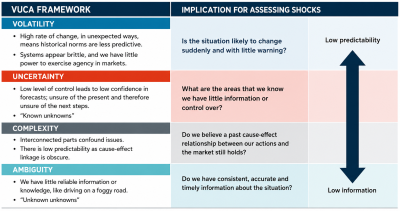
Forecasting is hard because the future rarely arrives in a straight line. Change often looks manageable at first, until it reaches an inflection point and accelerates. That is why finance teams need a practical way to name the uncertainty around them before they can quantify it, monitor it and decide what to do next. The VUCA framework — volatility, uncertainty, complexity and ambiguity — provides a useful lens for turning disruption into a structured conversation about risk and opportunity.
Volatility refers to fast, sharp changes that can disrupt performance even when the underlying issue is familiar. Finance professionals see this in commodity price swings, freight rates, currency movements or sudden customer demand shifts. The event may be recognizable, but the speed and magnitude of the movement can overwhelm a forecast that assumes stability.
Uncertainty is the realm of known unknowns. A company may know that a regulatory change, competitor launch, tariff decision or technology shift is possible, but not when it will happen or how material the impact will be. In these cases, the finance team’s role is not to predict a single answer, but to define the assumptions, watch the indicators and identify when the risk is moving closer to the forecast.
Complexity comes from interconnected systems where one disruption creates second- and third-order effects. Supply chains, post-merger integrations, enterprise technology platforms and global logistics are all examples. A port closure, warehouse fire or system outage may begin as an operational issue, but the financial impact can quickly spread through inventory, revenue timing, margin, cash flow and customer commitments.
Ambiguity appears when the situation is novel enough that the organization lacks a clear playbook. The pandemic and the rapid evolution of generative AI are examples: Leaders can see that the business environment is changing, but there may be no shared model for what the change means, what data matters or which actions will work.
For FP&A, VUCA is not just a vocabulary exercise. It is a way to connect external disruption to internal decision-making. Volatility asks, “How much movement can the forecast absorb?” Uncertainty asks, “Which assumptions are most exposed?” Complexity asks, “Where will the knock-on effects appear?” Ambiguity asks, “What do we need to learn before we can act?” Used well, the framework helps finance keep doubt alive in the forecast without creating panic.
If the CFO is going to serve as the chief risk integrator, finance needs more than better models. It needs operating mechanisms that bring risk into the work itself: driver-based forecasts that expose assumptions, scenarios that show ranges instead of false precision, trigger points that prompt action and business reviews that connect performance to choices.
This does not mean turning FP&A into a risk department. It means recognizing that modern finance already sits at the intersection of uncertainty and decision-making. When finance helps leaders see what is changing, what matters financially and what actions are available, it is doing risk management in the most practical sense.
The next articles in this series will explore how to build that capability into the finance function: first, by identifying the processes and cadences where risk should be embedded, and second, by defining the skills, tools and behaviors finance teams need to make risk-informed forecasting part of how the business operates.
A further explanation of specific steps that CFOs can take in response to disruption can be found in the Association for Financial Professionals’ complimentary AFP FP&A Guide to Navigating Business Turbulence.
Bryan has experienced the evolution of finance from backward‑looking reporting to forward‑looking, enterprise‑wide decision support. As the finance practice director at AFP and other advisory roles, Bryan helps the finance community navigate what’s next: being the steward of corporate capital through partnership, process and technology transformation in all its forms. His focus is on cutting through hype and translating big shifts into practical, usable insights for finance leaders.
He also coaches and advises finance leaders and teams on building modern FP&A capabilities, developing talent, and operating as true strategic partners to the business.