
The Power of Showing Up: 5 Lessons from the Road for CFOs
What 3,671 miles on a bicycle taught me about consistency, focus, performance, resilience, and becoming a better finance leader.
For the past 25 years, I’ve started almost every January with the same New Year’s resolution: Ride my bicycle an average of at least 10 miles per day for the year.
Some years, I’ve accomplished that goal. Other years, I haven’t. My success rate is about 50%. That’s better than a Major League Baseball player’s batting average, but not quite as impressive as a professional tennis player’s first-serve percentage!
I’ve never considered myself an extraordinary cyclist. I don’t race professionally, and nobody is waiting at the finish line with a trophy. I simply enjoy riding my bicycle, challenging myself, and seeing where the road takes me.
But somewhere along those thousands of miles, I began recognizing something interesting. The lessons I was learning on my bicycle were remarkably similar to those I have learned during my career in finance and leadership.
As of October 7, 2026, my cycling scoreboard looked like this:
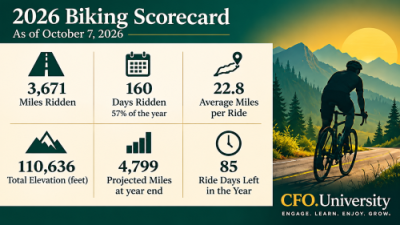
Those numbers are encouraging, but they aren’t the real story. The real story is about the days I didn’t feel like riding, the hills I wasn’t sure I could climb, the detours I hadn’t planned, and the satisfaction of making progress even when that progress felt insignificant.
After years of helping CFOs and finance leaders develop their capabilities, I’ve come to believe that professional success works much the same way.
Here are five lessons from the road that I believe every CFO can put to work.
Lesson 1: Consistency Beats Heroics
There’s something wonderfully ordinary about riding a bicycle regularly. Most rides aren’t memorable. There isn’t a breathtaking view around every corner, and not every outing produces a personal record.
Sometimes it’s windy. Sometimes it’s raining. Sometimes I’d rather stay home.
But the miles accumulate.
One 15-mile ride isn’t particularly impressive. String together hundreds of those rides, however, and something meaningful happens. Endurance improves. Hills become more manageable. Confidence grows. What once seemed difficult becomes routine.
I’ve found the same principle applies to financial leadership.
Organizations don’t become financially excellent because the CFO delivers one extraordinary presentation to the Board, closes one complicated transaction, or produces one brilliant forecast. Those accomplishments matter, but sustainable excellence comes from doing the important things well, repeatedly.
It’s the discipline of closing the books accurately and promptly every month. It’s maintaining a reliable cash forecast, not just when liquidity becomes tight. It’s developing team members throughout the year rather than waiting for annual performance reviews. It’s reviewing processes regularly and making incremental improvements instead of waiting for a crisis to force change.
In my experience, some of the most valuable improvements in finance departments aren’t particularly glamorous. Reducing the monthly close by one day, eliminating recurring reconciliation errors, or making management reports easier to understand may not generate headlines. But those improvements compound.
Consider what happens when a finance team improves a process by a small amount every month. Each individual improvement may appear insignificant, but over several years, the organization can operate very differently.
The CFO lesson: Don’t underestimate the cumulative power of small, disciplined improvements. Great finance organizations are built through consistency, not occasional heroics.
Further learning at CFO.University
Why Finance Transformation Should Start With a Fast and Efficient Financial Close — Christopher Argent
A strong match because it advocates starting small, thinking big, and building transformation through manageable, repeatable improvements.
3 Lean Lessons for CFOs — Rick Pay.
A practical examination of how Lean principles and disciplined operational improvements create better business performance.
Lesson 2: Focus on What’s Next, Not the Finish Line
One of the most important things cycling has taught me is how to approach a long, difficult climb.
When you’re pedaling up a steep hill, looking all the way to the summit can be discouraging. The distance seems enormous, your legs are getting tired, and progress can feel painfully slow.
I’ve learned that it’s often better to focus on the next bend in the road. Reach that bend, then focus on the next one. Eventually, you find yourself at the top.
The same philosophy applies to managing a finance organization.
CFOs face an almost endless collection of competing priorities. The Board wants better information. The CEO wants strategic insights. Investors want improved returns. Lenders want stronger cash flow. Employees want development opportunities. Meanwhile, the accounting department still needs to close the books, and the business continues generating new challenges.
The temptation is to tackle everything simultaneously. Unfortunately, when everything becomes a priority, nothing receives the attention it deserves.
I’ve worked with finance teams that were overwhelmed by enormous improvement agendas. They wanted to upgrade their ERP system, automate reporting, implement business intelligence tools, improve forecasting, redesign their budgeting process, and strengthen internal controls. All worthwhile objectives, but attempting everything at once frequently meant making little meaningful progress anywhere.
The more effective approach was to identify the few changes that would create the greatest business impact and tackle them sequentially.
This doesn’t mean abandoning the long-term vision. A cyclist needs to know where the road is leading, just as a CFO needs a clear strategic direction. But successful execution requires breaking that vision into manageable steps.
In finance, that might mean improving cash visibility before investing in a sophisticated forecasting platform. It might mean cleaning up master data before implementing advanced analytics. Or it might mean developing one excellent finance business partner before attempting to transform the entire finance organization.
The CFO lesson: Keep your destination in sight, but concentrate your energy on the next meaningful milestone. Progress accelerates when attention is focused.
Further learning at CFO.University
Planning — Scott Philips
An especially appropriate choice because it uses a mountain-climbing experience to explain how ambitious objectives require preparation, specific action steps, and disciplined execution.
When Being Right Is No Longer Enough — Steve Rosvold.
Introduces Decision Velocity and explains why finance leaders must focus on converting information into timely decisions and meaningful business results.

Lesson 3: The Scoreboard Isn’t Everything
I enjoy numbers. That probably doesn’t surprise anyone who has spent a career in finance!
My cycling computer tracks distance, elevation, speed, time, and other performance measures. I can tell you how far I’ve ridden this year, how many days I’ve been on the bicycle, and how much climbing I’ve accomplished.
These numbers are useful. They help me measure progress, identify trends, and stay motivated.
But they don’t tell the whole story.
My cycling computer can’t measure the enjoyment of an early morning ride, the satisfaction of conquering a challenging hill, the friendships developed along the way, or the mental clarity that comes from spending a couple of hours outdoors.
Some of my most rewarding rides have been among my slowest.
This is an especially important lesson for CFOs because we spend so much of our professional lives measuring performance.
Revenue growth, gross margin, EBITDA, return on invested capital, working capital, cash conversion, and dozens of other metrics help us understand business performance. They’re essential to making informed decisions.
But financial metrics are indicators of performance, not the entirety of performance.
Consider a business that improves its EBITDA margin by reducing employee development, postponing equipment maintenance, and cutting customer service resources. The financial scoreboard may look impressive in the short term, but the business could be quietly damaging its long-term competitive position.
Or consider a finance department that consistently closes its books in five days but produces reports that nobody uses to make better decisions. The team may be meeting its operational targets while failing to deliver its greatest potential value.
I’ve become increasingly convinced that CFOs must balance traditional financial measurements with indicators of organizational capability, customer value, employee engagement, and strategic progress.
This is one reason the Four Pillars of CFO Success at CFO.University encompass Accounting, Finance, Treasury, and Leadership. Excellence requires more than technical financial performance.
And here’s another lesson from my bicycle: Sometimes the most important information isn’t displayed on the dashboard.
A cyclist needs to pay attention to road conditions, weather, fatigue, and the behavior of other riders. A CFO needs to pay attention to culture, customer relationships, employee morale, emerging risks, and opportunities that haven’t yet appeared in the financial statements.
The numbers help us navigate. Judgment helps us understand what they mean.
The CFO lesson: Measure what matters, but remember that not everything that matters can be captured in a financial metric.
Further learning at CFO.University
Nonfinancial Performance Measures – Why They Matter - Zoheir Haider
Perhaps the strongest match of all ten recommendations. It directly addresses why financial metrics alone cannot capture business success, emphasizing customer loyalty, employee engagement, product quality, and innovation.
What Data Should You Track to Optimize Your Business Performance? - Prashanth Southekal.
Examines the importance of selecting the right business data to guide decisions rather than simply measuring everything available.
Lesson 4: Rest Isn’t Failure
Here’s something I didn’t fully appreciate when I began riding regularly: recovery is part of improving performance.
You can’t ride hard every day indefinitely and expect to keep getting stronger. Muscles need recovery. Energy needs replenishing. Sometimes the smartest decision is to take a day off or choose an easier route.
I’ve also learned that a missed riding day doesn’t mean I’ve abandoned my annual goal.
This lesson has particular relevance to the CFO profession.
Finance leaders have earned a reputation for working long hours, responding to emergencies, and pushing through difficult circumstances. During my career, I’ve seen teams work extraordinary hours to complete acquisitions, prepare budgets, resolve cash crises, and meet reporting deadlines.
There are certainly times when extraordinary effort is necessary. But there’s a dangerous difference between responding to an exceptional circumstance and allowing exceptional demands to become normal operating conditions.
When finance departments consistently depend on heroic effort, something is usually wrong with the underlying system.
Perhaps processes are inefficient. Maybe staffing levels are inadequate. Responsibilities may be poorly defined. Or leadership might be rewarding activity rather than results.
Whatever the cause, continually asking people to do more without addressing the underlying problems isn’t sustainable.
And the consequences extend beyond productivity. Exhaustion can affect judgment, creativity, collaboration, and the quality of decisions.
I’ve come to appreciate that effective leadership includes recognizing when people need to slow down, recover, and regain perspective.
It also means creating an environment where employees can speak openly about workloads, ask for help, and take time away without feeling that they’re letting the team down.
A rested finance team is often a more capable finance team.
The same applies to CFOs personally. Time with family, exercise, hobbies, travel, and activities unrelated to work aren’t distractions from professional success. They can be essential ingredients of sustained leadership effectiveness.
For me, cycling provides some of that balance. It’s an opportunity to think, reflect, and occasionally stop thinking about finance altogether!
The CFO lesson: Sustainable high performance requires recovery. A leader who never stops to recharge eventually risks diminishing the very performance they’re trying to improve.
Further learning at CFO.University
Sub-Optimization? Making Space for Serendipity and the Unexpected — Julie Winkle Giulioni
An excellent match. Challenges the obsession with maximizing productivity every minute and explains why creating breathing room can improve creativity, engagement, and well-being.
Self-Discovery: The Fulfillment Imperative for Today’s Leaders — Bernie Borges
Connects leadership effectiveness to balancing health, fitness, career, relationships, and personal fulfillment. Reinforces the importance of recovery and sustainable performance.

Lesson 5: Keep Going — Missing a Goal Doesn’t Mean Abandoning the Mission
Remember my 25-year New Year’s resolution?
I’ve achieved it only about half the time.
By conventional performance measurement, that’s a rather unimpressive record. Imagine presenting a Board with a 25-year history of achieving an important annual target only 50% of the time!
But here’s the question I keep coming back to: Would I have been better off abandoning the goal after the first unsuccessful year?
Of course not.
Over those 25 years, I’ve ridden thousands of miles, improved my fitness, enjoyed countless experiences, and developed friendships and memories that have enriched my life.
The annual target gave me direction and motivation. Missing it occasionally didn’t erase the value of the journey.
This is an important distinction for CFOs.
Business plans rarely unfold exactly as anticipated. Acquisitions don’t always deliver expected returns. Technology implementations run into difficulties. Forecasts miss their targets. Strategic initiatives encounter obstacles nobody anticipated.
These outcomes require accountability and honest assessment. We need to understand what went wrong, learn from the experience, and make necessary adjustments.
But missing a target shouldn’t automatically mean abandoning a worthwhile objective.
I’ve seen organizations react to disappointing results by changing direction too quickly. A strategy doesn’t produce immediate returns, so leadership launches a new one. An improvement program encounters resistance, so it gets replaced. A technology investment takes longer than expected, and enthusiasm disappears.
Sometimes changing course is absolutely the right decision. But sometimes the organization simply hasn’t allowed enough time for the investment to produce results.
Successful finance leaders must develop the judgment to distinguish between persistence and stubbornness.
Persistence means continuing toward a worthwhile objective while learning and adapting. Stubbornness means ignoring evidence that the objective or approach no longer makes sense.
On a bicycle, I may need to change routes because of road construction, weather, or fatigue. That doesn’t mean I’ve stopped being a cyclist.
Similarly, a CFO may need to revise a strategic plan, adjust investment priorities, or redesign an initiative without abandoning the organization’s long-term mission.
And perhaps most importantly, leaders need to help their teams understand that setbacks are opportunities to learn, not reasons to disengage.
The CFO lesson: Be accountable for results, flexible about methods, and persistent about purpose. One missed target doesn’t define a career, a team, or an organization.
Further learning at CFO.University
Why Failure Is Not About Losing — Steve Rosvold
This is an exceptionally strong fit for your cycling story. Your article argues that missing a goal doesn’t make someone a failure and that the experiences, learning, and personal growth along the journey are often more important than achieving the original target.
A Great Lesson for CFOs from the Sporting World — Steve Rosvold
Uses lessons from competitive athletics to explain resilience, learning from mistakes, and moving forward after setbacks. Its emphasis on identifying, diagnosing, and advancing fits your message of continuing to ride even after missing an annual goal.
The Bigger Lesson: Leadership Is a Journey, Not a Destination
Image placement: Insert The Power of Showing Up – 5 Lessons.png here as the visual recap of the article’s five central messages.
When I look back over my cycling experiences, the most meaningful memories aren’t necessarily associated with the longest rides or fastest speeds.
They’re the unexpected conversations, the spectacular views, the challenging climbs, and the quiet satisfaction of getting out on the road when staying home would have been easier.
The same is true of my professional career.
The accomplishments I’m proudest of aren’t always the transactions completed, financial results achieved, or projects delivered. They’re often the people I’ve worked with, the challenges we’ve overcome together, and the opportunities I’ve had to help others develop their capabilities.
That’s one of the reasons I founded CFO.University.
I believe that developing world-changing finance leaders requires more than teaching technical skills. It requires helping people become better thinkers, stronger leaders, more effective collaborators, and more confident decision-makers.
Our Four Pillars of CFO Success — Accounting, Finance, Treasury, and Leadership — provide a framework for that development. But mastering those disciplines isn’t something we accomplish through a single course, workshop, or professional achievement.
It’s a lifelong journey of learning, practicing, improving, and occasionally stumbling along the way.
And like cycling, the journey is considerably more enjoyable when we appreciate the experience rather than obsessing over the destination.
Five questions worth asking yourself
As you reflect on your own finance leadership journey, consider these questions:
1. Consistency: What small improvement could my team make regularly that would create meaningful long-term value?
2. Focus: Are we concentrating on the few priorities that matter most, or spreading ourselves too thin?
3. Measurement: Does our performance scoreboard capture what truly creates value, or merely what is easiest to measure?
4. Recovery: Are we building a sustainable high-performing team, or depending too heavily on extraordinary individual effort?
5. Persistence: When we encounter setbacks, are we learning and adapting, or abandoning worthwhile goals too quickly?
You don’t have to be an extraordinary cyclist to appreciate the benefits of showing up regularly. And you don’t have to be an extraordinary CFO every single day to accomplish extraordinary things over the course of your career.
You simply need a worthwhile destination, a commitment to improve, the judgment to navigate obstacles, and the willingness to keep moving forward.
The most important mile may not be the fastest, the longest, or the most difficult. It may simply be the next one.
Ride Safe! Have Fun!
And in your professional life…
Engage. Learn. Enjoy. Grow.

About CFO.University
CFO.University is a professional development center dedicated to developing world-changing finance leaders. Through articles, courses, practical tools, coaching, and a global professional community, we help current and aspiring CFOs strengthen their skills across the Four Pillars of CFO Success.
Explore the CFO.University Library and discover more learning opportunities at CFO.University.
Already a Member? Login HERE.
Identify your path to CFO success by taking our CFO Readiness Assessmentᵀᴹ.
Become a Member today and get 30% off on-demand courses and tools!
For the most up to date and relevant accounting, finance, treasury and leadership headlines all in one place subscribe to The Balanced Digest.
Follow us on Linkedin!
