Current Global Geo-Political and Economic Risk Events and Trends
Building CFO Resilience in Uncertain Times
Editors note: We are excited to release this special and timely report by Jenna Wells, CEO at Supply Wisdom. Jenna explores the most pressing developments in the current financial environment and examines their implications for CFOs with recommended actions they should be taking. It’s a roadmap for CFOs striving to become more strategic in their risk management role.
The responsibilities of Chief Financial Officers (CFOs) have evolved dramatically in recent years. No longer confined to compliance and reporting, CFOs are now expected to act as strategic leaders who anticipate risks, guide organizations through uncertainty, and communicate effectively with stakeholders. They increasingly serve as the enterprise’s chief risk integrator, connecting macroeconomic signals, geo-political developments, regulatory shifts, and capital strategy into a coherent financial response.
In 2026, the global financial landscape is being shaped by currency volatility, regulatory reforms, modest economic growth, and heightened geo-political risk. Persistent inflation, fragile supply chains, fiscal imbalances, and technology-driven disruption further compound uncertainty. This report offers insights into how risk management must evolve to meet the challenges of today’s interconnected world.
Global Financial Crises and Their Implications
• US Tariff Escalations and Trade Risks
US tariff increases announced in 2025 targeting key trading partners have accelerated market selloffs and heightened concerns around supply-chain disruption. Equity indices moved toward bear-market territory as investors priced higher import costs, while the World Trade Organization (WTO) warned of a potential global trade contraction of 0.2% to 1.5%.
Trade policy uncertainty has reintroduced volatility into pricing, sourcing, and inventory planning across multiple sectors. Tariffs averaging around 16% are expected to raise input costs for electronics and manufacturing by 10–20%, directly pressuring margins. In response, global companies are diversifying supplier bases away from China, a transition that is increasing near-term capital expenditure and working-capital requirements. Market analysts caution that if tariffs persist into 2026, the probability of a US recession rises, with downside scenarios projecting a 5–15% decline in export revenues.
Implications: For CFOs, tariff escalation is direct earnings, cash-flow, and balance-sheet risk. Priorities include reassessing sourcing costs, analyzing sourcing alternatives, testing margin pass-through, and embedding tariff-driven inflation into forecasts. CFOs should lead downside scenario modeling for revenue pressure and supply-chain shifts, expand FX hedging to manage volatility, and evaluate selective localization to reduce exposure. Capital planning must account for higher geo-political risk through stronger liquidity buffers, while clear board and investor communication is essential to maintain confidence in earnings resilience.
Actions taken to mitigate these new risks should be considered with the long term shifts in raw material costs outlined in this article, In a Volatile Economy, Purchasing Practices Need to Change
• The US–Iran War and Strait of Hormuz Closure
One On February 28, 2026, the United States and Israel launched airstrikes on Iran, targeting military and government sites. Iran responded with missile and drone strikes against US bases and allies across the Middle East and closed the Strait of Hormuz to international shipping. The Strait had previously carried roughly 25% of the world’s seaborne oil trade and 20% of global liquid natural gas. Following the closure, tanker traffic dropped to near zero, with over 150 vessels anchoring outside the strait to avoid attacks.
The International Energy Agency (IEA) characterized the disruption as the largest oil supply shock in the history of global energy markets, with parallels drawn to the 1970s energy crisis. Brent crude surged past $120 per barrel following the strait’s closure, and QatarEnergy declared force majeure on all LNG exports. Modeling from the Federal Reserve Bank of Dallas suggests that a two-quarter outage could push WTI crude to $132 per barrel, with a three-quarter disruption potentially reaching $167.
The International Monetary Fund (IMF) warned that its global outlook had “abruptly darkened,” downgrading 2026 growth to 3.1% in a short-conflict scenario, while a prolonged Hormuz disruption could drag global growth to approximately 2% and push inflation toward 6%, approaching recessionary conditions. As of mid-April, a US naval blockade of Iranian ports is in effect following the breakdown of nuclear talks, with the Islamic Revolutionary Guard Corps (IRGC) warning that any US military vessels approaching the strait would constitute a ceasefire violation.
Implications: For CFOs, the Hormuz crisis is no longer a tail risk, it is an active, material threat to energy costs, supply chains, and capital markets. CFOs outside the energy sector cannot assume insulation from oil price shocks, given the pervasive indirect effects across logistics, manufacturing inputs, and inflation. Immediate priorities include stress-testing P&L against sustained oil prices above $120, reviewing energy hedging positions, assessing supplier dependencies in the Gulf region, and modeling cash flow under stagflationary scenarios. Strategic reserve planning, force majeure clauses, and insurance coverage for supply chain disruption warrant urgent board-level review.
CFOs should immediately have all all significant customer and vendor contracts reviewed to determine the company’s ability to pass on increased costs to customers or vendor options to increase raw material pricing. (i.e. freight surcharges, length of contracts, min/max volume commitments, penalties for nonperformance, etc.)
• Inflationary Pressures Across Emerging Markets
Beyond Iran, inflationary pressures continue to test resilience across Asia, Africa, and Latin America. Elevated food and energy prices have strained household budgets and triggered social unrest in several countries. For multinational corporations, this translates into higher operating costs, unpredictable demand patterns, and potential disruptions in labor markets.
Implications: CFOs must balance cost control with strategic investment, ensuring that liquidity buffers are sufficient to withstand shocks while still enabling growth initiatives. Inflation also challenges CFOs to rethink pricing strategies, supply chain contracts, and capital allocation decisions. The ability to model multiple inflation scenarios and communicate their implications to boards and investors is now a critical leadership skill.
Market Performance Risks Identified Through Ongoing Monitoring:
This chart highlights the range of financial crises and regulatory changes tracked through ongoing monitoring, categorized by their potential impact on corporate operations. The events capture developments such as currency collapses, inflationary surges, tax and pension reforms, GST rationalization, and evolving global compliance mandates. By mapping these events according to severity, the chart provides CFOs with a clear view of how frequently such disruptions occur and the intensity of their implications. This distribution supports early recognition of systemic risks, enabling CFOs to anticipate financial exposure, strengthen resilience strategies, and ensure informed oversight in an increasingly volatile regulatory and economic environment.
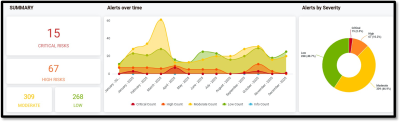
Source: Supply Wisdom Share Price Decline, Stock Market Performances, Inflation, Financial Trends, Trade, and Currency Fluctuations Alerts from January 01, 2025, to December 31, 2025
Global Geo-political Crises and Their Implications
Escalation of Middle East Conflict and Red Sea Shipping Disruptions
Escalation of Middle East Conflict and Red Sea Shipping Disruptions
Ongoing military escalations in the Middle East have expanded beyond localized conflict, disrupting key maritime trade routes, particularly the Red Sea and Suez Canal. Repeated attacks on commercial vessels and rising insurance premiums have forced shipping reroutes via the Cape of Good Hope, increasing transit times by up to two weeks and driving freight costs materially higher.
Implications: For CFOs, prolonged shipping disruption translates directly into higher logistics costs, inventory shortages, and working-capital strain. Energy price volatility further compounds cost uncertainty. CFOs must reassess inventory buffers, renegotiate freight contracts, and model cash-flow impacts from extended lead times. Scenario planning for supply-chain shocks is now essential to protect margins and customer commitments.
If you don’t have a cash flow forecasting tool, now is the time to be using one – here is a great place to start: 13 Week Cash Flow Forecast
• US–China Strategic Decoupling and Technology Controls
Geo-political rivalry between the US and China continues to deepen through export controls, investment restrictions, and technology sanctions; particularly in semiconductors, artificial intelligence, and critical minerals. These measures are fragmenting global supply chains and limiting market access for multinational firms.
Implications: CFOs must evaluate revenue concentration risks, stranded assets, and compliance exposure arising from competing regulatory regimes. Capital allocation decisions increasingly require geo-political risk screening. Failure to align investment strategy with evolving geo-political blocs can result in write-downs, forced divestments, or sudden loss of market access.
• Russia–Ukraine War and Prolonged Energy and Food Security Risks
The ongoing Russia–Ukraine conflict continues to disrupt global energy, fertilizer, and grain markets. Sanctions regimes remain fluid, while infrastructure attacks heighten uncertainty around supply continuity, particularly for Europe and emerging economies dependent on imports.
Implications: Energy and input cost volatility complicates budgeting and pricing strategies. CFOs must hedge commodity exposure, reassess supplier dependencies, and prepare for regulatory compliance with evolving sanctions. The conflict reinforces the need for geo-political stress testing across procurement, treasury, and compliance functions.
Raw Materials: Are You “Buying Right”? highlights the key requirements CFOs should ensure are in place to ‘protect’ cost of goods sold, half of the gross profit equation. “Bought right, is half sold!”
• Geo-political Instability and Political Unrest in Emerging Markets
Political instability, contested elections, and social unrest continue to escalate across parts of Latin America, Africa, and South Asia. These events often trigger abrupt policy shifts, capital controls, currency devaluations, or disruptions to critical infrastructure.
Implications: CFOs operating in high-risk jurisdictions must prepare for sudden operational shutdowns, cash repatriation challenges, and legal uncertainty. Maintaining diversified country exposure, local contingency planning, and continuous geo-political monitoring is critical to safeguarding financial performance and enterprise value.
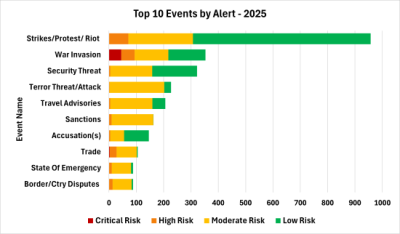
Source: Supply Wisdom Geo-Political Alerts from January 01, 2025, to December 31, 2025
Current Financial and Geo-political Trends:
• Inflation Resurgence and Monetary Policy Shifts
Inflation pressures reemerged in late 2025 due to artificial intelligence (AI)-driven supply bottlenecks and energy constraints. Data centers now strain power grids, potentially accounting for 10% of US demand by 2030, risking blackouts and price spikes. US inflation, after peaking at 9.1% in 2022, shows signs of rebounding if wage growth accelerates amid tighter immigration rules.
For CFOs, this means revisiting pricing strategies and working capital buffers. Federal Reserve rate cuts, anticipated more aggressively if an AI bubble burst, could ease borrowing but fuel asset bubbles elsewhere. Market analysts have sharply revised recession probabilities upward for 2026, with the IMF warning that a prolonged Hormuz disruption could push global inflation toward 6% while dragging growth to approximately 2%, conditions consistent with stagflation. CFOs should stress-test balance sheets for inflation upticks of 4–6% and model scenarios where rate cuts are delayed or reversed as central banks face the dilemma of easing into a supply-driven price shock.
Inflation is a two-edged sword for CFOs. Learn how here: The CFO’s Fight For and Against Inflation
• Fiscal Policy and Bond Market Vulnerabilities
The US fiscal deficits, hovering at 6-7% of GDP, pose bond investor concerns as debt issuance swells. Proposals for US$2,000 tariff rebate checks ahead of midterms echo COVID-era stimulus, risking inflation resurgence. European nations face similar pressures from defense spending and aging demographics, potentially triggering austerity if yields spike.
CFOs should prioritize liquidity stress tests, maintaining 6-12 months of cash reserves against yield shocks. Corporate bond spreads have widened materially into early 2026, with the Hormuz crisis and associated energy shock compounding existing fiscal pressures. BBB-rated issuers now face refinancing cost increases well beyond the 50–100 basis points seen in Q4 2025, and the window for locking in fixed-rate debt is narrowing as inflation expectations are revised higher. Scenario planning around Transmission Protection Instruments in Europe can guide cross-border investments.
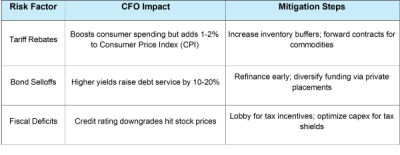
. .Risk Factor CFO Impact Mitigation Steps
• Escalation of Regional Conflicts and Supply Chain Disruptions
Regional conflicts expanded in strategic corridors during 2025, disrupting shipping routes, energy flows, and insurance markets. Maritime security risks in key chokepoints increased freight costs and transit times, while cyber and physical attacks on infrastructure heightened operational uncertainty. Energy-importing economies faced renewed price volatility as conflict-driven supply interruptions intensified.
For CFOs, conflict escalation elevates logistics costs, inventory requirements, and business interruption risks. Companies must revisit insurance coverage, increase safety stock for critical inputs, and model downside scenarios for prolonged transport disruptions. Strengthening contingency planning and supplier redundancy is critical to maintaining operational continuity.
• Rising Political Polarization and Policy Volatility
Political polarization deepened across major economies ahead of election cycles, driving abrupt policy shifts in taxation, trade, immigration, and industrial subsidies. Short-term political priorities increasingly overrode long-term economic planning, resulting in inconsistent regulatory signals and heightened investor uncertainty. Policy reversals became more frequent, complicating strategic decision-making.
For CFOs, policy volatility increases forecasting error and capital allocation risk. Financial leaders must shorten planning cycles, incorporate policy-driven downside cases, and maintain flexibility in capex commitments. Active monitoring of legislative developments and proactive engagement with policymakers can help mitigate unexpected regulatory shocks.
• Expansion of Sanctions, Export Controls, and Economic Nationalism
Sanctions regimes expanded in scope and enforcement during 2025, extending beyond defense into technology, finance, and industrial goods. Governments increasingly used economic tools to advance national security objectives, restricting cross-border capital flows, technology transfers, and foreign ownership. Compliance costs rose as enforcement intensified across jurisdictions.
For CFOs, sanctions and economic nationalism heighten legal, financial, and reputational risks. Firms must strengthen trade compliance frameworks, assess customer and counterparty exposure, and prepare for sudden market exits. Scenario planning for revenue loss, asset write-downs, and trapped cash becomes essential under prolonged geo-political tension.
• Regulatory Changes in Shaping Compliance
New Securities and Exchange Commission (SEC) rules on climate disclosures, effective 2026, require CFOs to quantify emissions across scopes 1-3, impacting reporting timelines. European Union (EU’s) Corporate Sustainability Reporting Directive expands similarly, with fines up to 10 M euros for non-compliance. CFOs need integrated ESG software to streamline data flows, avoiding audit delays.
US President’s deregulation push eases some burdens but introduces tariff-related customs scrutiny. CFOs should train teams on updated trade compliance, as misclassification risks penalties doubling import duties. Basel IV implementations raise capital requirements for banks, indirectly tightening credit for corporates by 5-10%.
• AI and Tech Sector Volatility
An AI bubble burst remains a top 2026 risk, with tech stocks vulnerable if monetization falters. Massive investments in hardware crowded out other sectors, fueling consumption among high earners but risking wealth wipeout. CFOs in tech-adjacent firms face capex overruns; reallocating 20% of AI budgets to core operations builds resilience.
Yet AI offers upside: productivity gains could curb inflation long-term. CFOs balancing hype with reality should pilot use cases in finance, such as predictive cash forecasting, yielding 10-15% accuracy improvements.
Strategic Risk Management for CFOs
Global growth forecasts dipped to 2.6-3.1% through 2026, with US slowing to 1.5-1.8%. CFOs must integrate these trends into enterprise risk frameworks, using Monte Carlo simulations for probabilistic forecasting. Key actions include:
• Enhance Forecasting: Incorporate tariff scenarios into rolling 18-month plans.
• Build Resilience: Diversify revenue streams; target 30% from non-US. markets.
• Leverage Technology: AI for anomaly detection in treasury operations.
• Foster Collaboration: Align with CEOs on M&A amid undervalued assets post-crash.
By embedding these into board discussions, CFOs turn volatility into competitive advantage. UN challenges highlight geo-political risks, reinforcing the need for agile strategies.
• This article from Jenna provides more detail on what CFOs should be working toward to strengthen Strategic Risk Management in their businesses, Risk Management: A Core Driver of Financial Resilience for CFOs
Conclusion
The financial crises and regulatory changes of 2025–2026 highlight the rapidly evolving role of CFOs in an environment shaped by both economic volatility and escalating geo-political uncertainty. From Iran’s currency collapse and inflationary pressures to trade fragmentation, sanctions expansion, and regional conflicts, CFOs must navigate complexity with agility. Risk management is no longer a peripheral function it is central to corporate strategy. The challenge for CFOs is to anticipate risks, adapt to regulatory shifts, and lead with resilience. By strengthening treasury functions, investing in compliance automation, aligning financial and IT risk strategies, embedding geo-political risk monitoring into enterprise risk frameworks, and communicating transparently with stakeholders, CFOs can transform risk management into a source of competitive advantage. In conclusion, the current financial landscape demands that CFOs move beyond traditional compliance roles to become strategic leaders in risk management. The crises and reforms of 2026 are not isolated events but part of a broader pattern of persistent geo-political fragmentation, policy volatility, and economic realignment. CFOs who embrace this reality will not only safeguard their organizations but also position them for growth in an uncertain world. The path forward requires agility, foresight, and resilience qualities that define the modern CFO.
Utilizing a 3rd party risk intelligence platform such as Supply Wisdom can help CFOs gain early, actionable visibility into financial, regulatory, and geo-political risks that can impact performance, operations, and governance. By continuously monitoring risks across domains such as sanctions, trade policy, macroeconomic shifts, and geo-political disruptions, SW translates external risk signals into business-relevant insights that support informed decision-making and stronger organizational resilience.
Already a Member? Login HERE.
Identify your path to CFO success by taking our CFO Readiness Assessmentᵀᴹ.
Become a Member today and get 30% off on-demand courses and tools!
For the most up to date and relevant accounting, finance, treasury and leadership headlines all in one place subscribe to The Balanced Digest.
Follow us on Linkedin!
