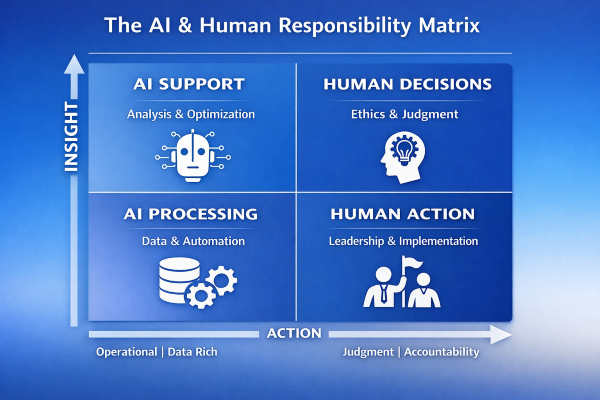
The AI 2×2: Where It Does Well vs Where It Falls Short
Introduction
Artificial intelligence (AI) is one of the most talked-about technologies today. Solutions such as Assistants, Copilot, Autopilots, and Agents offer significant efficiency, and performance improvements But alongside the excitement, there is also confusion. Many people either overestimate what AI can do or underestimate its limitations. To use AI effectively in business, work, or daily life, you need a clear, grounded understanding of both its strengths and its limitations. When used correctly, AI can create enormous value. When misunderstood, it can lead to poor or even catastrophic outcomes. The reality sits in between. AI is a powerful tool, but only when you understand both what it can do and what it cannot.
What AI can do
1. Derive Insights and Execute Actions from Data
The primary strength of AI is its ability to process and analyze large amounts of diverse data. AI can scan millions of documents, images, or records in a fraction of the time a person can. It identifies patterns that create insights. These patterns and insights can be used to automate and optimize of processes. For example, businesses generate vast amounts of data every day such as customer interactions, transactions, operational metrics, and more. AI can analyze this data to uncover insights, detect inefficiencies, and recommend improvements. In many cases, it can even automate decisions based on those insights, such as recommending products, flagging fraud, or forecasting demand. Put simply, if a product or service generates usable data, AI can often help improve or automate it. This is where much of AI’s real value lies: turning data into action.
2. Automate Repetitive Tasks at Scale
The second major strength of AI is automation at scale i.e. automating routine, rule-based work that follows predictable patterns. Tasks such as data entry, scheduling, document sorting, and basic customer support are performed repetitively at scale. With AI these tasks can be performed faster and more consistently than humans can perform them. These tasks are often necessary but time-consuming, and they rarely require deep thinking or creativity. For example, in hiring, AI can scan thousands of resumes and shortlist the most relevant candidates, saving significant time. However, the final decision still requires human judgment. In this way, AI acts as a force multiplier: it doesn’t replace human effort, but it amplifies it.
What AI cannot do (at least not reliably today)
1. Reasoning from First Principles
One of AI’s biggest limitations is handling completely new situations. Trained on historical data, it relies on past patterns to make predictions and cannot reason from first principles. AI excels at generating insights from existing data, like summarizing market reports, analyzing customer feedback, or drafting a LinkedIn post. However, creating truly novel ideas, such as inventing a new product or writing an original story, remains a challenge. In unfamiliar scenarios, AI can produce inaccurate or misleading outputs because it lacks contextual understanding and intuition. This makes human oversight essential, especially in complex or high-stakes situations.
2. Directly fix Physical, Real-world Problems
AI cannot directly fix physical, real-world problems. It operates in the digital realm and is dependent on data. It can analyze, recommend, and optimize, but it cannot physically act. For example, AI can suggest how to fix a leaking tap, but it cannot perform the repair itself (unless it is connected to a physical system such as a robot). Another relevant example relates to customer service. AI can analyze customer complaints, detect sentiment, and recommend appropriate responses. However, it cannot personally resolve a frustrated customer’s emotions or rebuild trust. A human must step in to listen, empathize, and make judgment-based decisions on how to handle the situation. The final solution still depends on human judgment, as AI cannot determine what is right or wrong. This distinction becomes particularly important in areas involving ethics, risk, or long-term consequences.
Conclusion
Overall, AI depends on data. If something cannot be measured, digitized, or tracked, AI has little to work with. Many real-world problems involve ambiguity, human behavior, or unstructured environments, areas where data is incomplete or difficult to define. In these situations, AI’s usefulness becomes limited.
In the end, the best way to think about AI is not as a replacement for humans, but as a complement to human capabilities. AI excels at speed, scale, and pattern recognition. Humans excel at judgment, context, and responsibility. When these strengths are combined effectively, the result is far more powerful than either one alone. Overall, understanding this balance is key. AI is not a solution to every problem, but in the right context, it can be a transformative tool that can significantly amplify performance.
Already a Member? Login HERE.
Identify your path to CFO success by taking our CFO Readiness Assessmentᵀᴹ.
Become a Member today and get 30% off on-demand courses and tools!
For the most up to date and relevant accounting, finance, treasury and leadership headlines all in one place subscribe to The Balanced Digest.
Follow us on Linkedin!
