From Hype to Hard Reality: The Real Barriers to AI Agents in Enterprises

State of AI in Enterprises
In the recent weeks, there has been lot of discussions about AI agents and enterprise productivity. AI agents are a powerful phrase. It signals autonomy, intelligence, scale. It promises faster decisions, lower costs, and smarter operations. The possibilities sounded transformative. But here is the uncomfortable truth: implementing AI agents in the enterprise is extraordinarily hard. In fact, a recent MIT study found 95% of enterprise AI pilots fail to deliver measurable value [1]. Over four in 10 businesses in US have scrapped at least one AI initiative in 2025, up from 17% in 2024, according to analysis from S&P Global Market Intelligence.
AI Challenges in Enterprises
Despite the massive interest, investments and executive enthusiasm, most enterprise AI initiatives are failing to deliver measurable value. Many don’t proceed beyond the pilot or PoC stage. Others get abandoned after limited business impact. The gap between AI’s promise and enterprise reality remains wide. Implementing AI agents is hard; not because the technology isn’t powerful. It’s hard because deploying AI agents isn’t a software upgrade; it’s a redesign of how work gets done. And workflow redesign is deeply human. It’s political. It challenges decision rights, exposes inefficiencies, shifts power, and forces operational change. In short, AI agents don’t fail because of algorithms. They struggle because organizations weren’t built for them.
Digitally native firms like Waymo, Uber, Stripe, and DoorDash can embed AI into their DNA from day one easily. But legacy enterprises such as Procter & Gamble, Johnson & Johnson, or ExxonMobil or Boeing, have decades-old operating models, compliance layers, and human-centered processes. They will face far deeper cultural, structural, and operational friction when attempting the transformation with AI. This doesn’t mean traditional enterprises cannot succeed with AI. They can. But their advantage won’t come from simply deploying AI agents. It will come from redesigning workflows, redefining roles, and rebuilding data foundations with intention.
Why implementing AI Agents is hard
In this backdrop here are 3 reasons on why implementing AI Agents is hard for most enterprises.
1. Current Workflows are built around Human Constraints
Enterprise workflows are built for human decision making, manual approvals, and to handle departmental silos. In this organization structure, you can’t simply plug in AI Agents before workflows are redesigned. AI excels with repeatable patterns and defined rules. But real businesses often face edge cases and ambiguity, requiring constant human intervention. Basically, effective adoption of AI Agents requires a complete true architectural and workflow redesign, not simple tool deployment.
2. Role and Power Shifts Create Resistance
When AI agents draft procurement contracts, approves vendor invoices, screen resumes for HR, or generate FP&A reports, they are also redistributing decision power and accountability. This can result in loss of control (for Managers), layoffs, ownership issues, or exposed inefficiencies, and ultimately slow down AI Agent implementation.
3. In most enterprises Data Is Messy and AI Depends on Quality Data
AI agents need clean data coming from integrated operational systems to define and standardize rules. But most organizations rely on multiple spreadsheets with inconsistent definitions, legacy systems with diverse data models, duplicate and redundant processes, and tribal knowledge, and more. All this results in messy data, where the data is incomplete, inaccurate, and outdated. This impacts the implementation of AI agents as AI depends on quality data.
The Solution
So, what should enterprises do to implement AI agents? Overall, implementing AI Agents in traditional Enterprises depends on redesigning and reengineering three main elements – Workflows, Roles, and Data. Organizations must redesign workflows from end to end. This means clearly defined rules, structured decision paths, and repeatable patterns. Successful AI includes transition from “humans act, systems record” to “AI acts, humans supervise”. This transition is not a technical shift; it is an organizational one as roles determine who trusts and governs it. AI agents are only as effective as the data they rely on. Without quality data governance and infrastructure, AI agents amplify errors instead of reducing them.
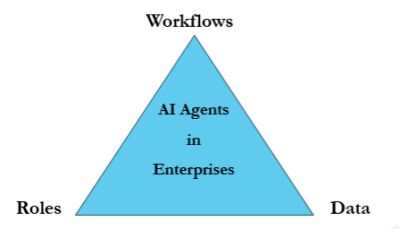
Figure 1: AI Agents in Enterprises
The traditional model is, humans act and the systems record. But in the AI model, AI acts and humans govern. This change demands trust, new KPIs, redesigned workflows, roles and responsibilities, and retraining. RPA (Robotic Process Automation) too promised significant efficiency gains, but many RPA implementations failed to deliver strong ROI. While Bots could easily automate repetitive tasks, yet complex and edge workflows, bad data, and workflow constraints limited their impact.
Conclusion
A recent study Forrester says that AI and automation will reshape workflows and influence 20% of jobs by 2030. But only about 6% of U.S. jobs are expected to be fully replaced [3]. This is basically emphasizing the need for human-centered strategies that enhance productivity alongside AI. The future is NOT, AI or Human, it is AI and Human, especially in the enterprise world. Overall, implementing AI agents is not a tool upgrade. They are an operating model shift. And the winners won’t be those who add AI Agents. They will be those who redesign how work gets done ethically, legally and responsibly.
References
1. https://mlq.ai/media/quarterly_decks/v0.1_State_of_AI_in_Business_2025_Report.pdf
2. https://www.forbes.com/councils/forbestechcouncil/2025/09/22/why-42-of-ai-projects-fail-and-how-orchestration-can-save-yours/
3. https://www.forrester.com/press-newsroom/forrester-impact-ai-jobs-forecast/
Already a Member? Login HERE.
Identify your path to CFO success by taking our CFO Readiness Assessmentᵀᴹ.
Become a Member today and get 30% off on-demand courses and tools!
For the most up to date and relevant accounting, finance, treasury and leadership headlines all in one place subscribe to The Balanced Digest.
Follow us on Linkedin!
